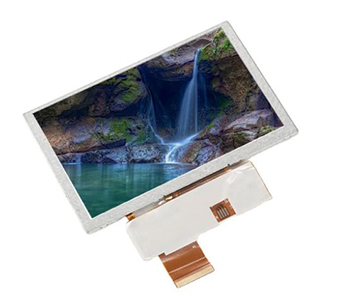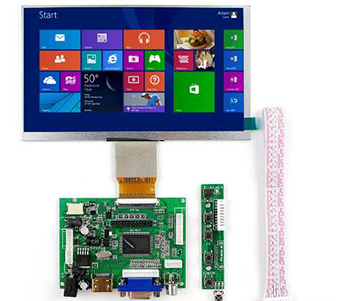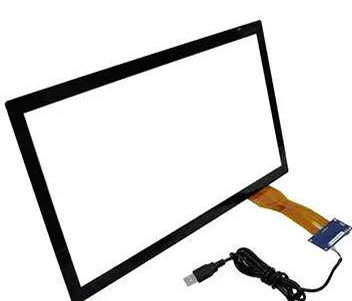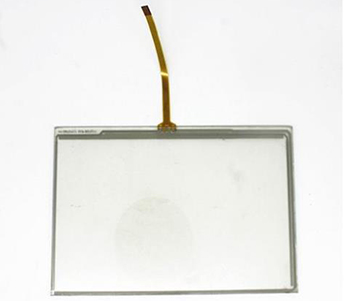
There are generally two types of touch screens: capacitive touch screens and resistive touch screens. Next, we will introduce the working principle of resistive touch screens.
Resistive touch screens can be divided into three types in terms of design: 4-wire, 5-wire, and 8-wire. The working principle of each type is similar, and will be briefly introduced below.
Due to factors such as cost and mature technology, 4-wire touch screens are the most basic production specification for almost all touch screen practitioners. In terms of the technology of resistive touch screen, 4-wire touch screens account for more than 50% of the market. Its composition mainly includes an ITO film conductive film and an ITO glass conductive glass, both of which are conductive using a voltage of +5V (some manufacturers use a voltage different from +5V). The spacer is used to separate the ITO film and ITO glass in the middle part of these two conductive layers, in order to avoid short-circuits and misoperations caused by no touch.
The main working principle of the 4-wire resistive touch screen is to regard the lower and upper parts as the Y-axis and X-axis coordinates to work. Two conductive wire circuits are added around the ITO film and ITO Glasss on the four sides of the edge, and a fixed voltage is set at both ends to create a uniform electric field.
Because there is a dot spacer between the upper and lower parts as a barrier, the upper and lower layers are insulated. If the panel is pressed by a pen, finger, or other medium, the two layers will contact and cause a short circuit, resulting in a drop in voltage.
The main composition method of the 5-wire touch screen is basically the same as that of the 4-wire touch screen, that is, the ITO film and ITO glass are divided into upper and lower layers of conductive layers, and they are still conductive using a voltage of +5V after being conductive. The spacer is also used to separate the upper and lower layers. The biggest difference is that the 4-wire touch screen controls two conductive wires for the X-axis and Y-axis respectively, while the 5-wire touch screen controls four wires for the X-axis and Y-axis on the lower conductive layer.
The upper layer is responsible for measuring the voltage pressed on the X-axis and Y-axis, and the voltage value detected by it will be transmitted to the controller, then the coordinates will be obtained, and the digital signal will be transmitted to the host after being converted. Because the upper layer is a uniform conductive layer, any point can be responsible for transmitting the voltage, compared with the 4-wire resistive touch screen, which has high durability, the 5-wire touch screen can maintain consistent accuracy and sensitivity in harsh environments.
Strictly speaking, the 8-wire product is an extension of the 4-wire product, because in order to avoid errors in the voltage reading caused by the environment or other peripheral equipment, in addition to the 4 lead wires for the upper and lower conductive layers, one reference wire is added to each, totaling 8, in order to read more practical voltage values and improve the accuracy of operation.
 Advantages of WUXGA TFT Display Over Traditional Screen TechnologiesMay 9, 2024As technology continues to advance, display technology is also changing rapidly. In many screen technologies, WUXGA (Wide Ultra Extended Graphics Array) TFT (thin-film transistor) display with its uni...view
 Enhancing the Gaming Experience with TFT Display Touch ScreensDecember 8, 2023In the ever-evolving landscape of gaming technology, one innovation stands out as a game-changer—TFT display touch screens. These sleek and responsive screens have taken the gaming experience to new ...view
 Implementing Multi-Touch Technology in Industrial TFT DisplaysMay 9, 2024With the continuous development of industrial automation, industrial TFT display, as the key equipment for human-computer interaction, are expanding their functions. As an advanced interaction method,...view
 How the TFT display worksDecember 9, 20221. How does TFT display work?How does TFT display work? TFT is the abbreviation of Thin Film Transistor, which generally refers to thin film liquid crystal display, but actually refers to ...view
 Exploring the Features of Car LCD Modules for an Enhanced Driving ExperienceJanuary 25, 2024In today's advanced automotive industry, car LCD modules have become an essential component for enhancing the driving experience. These innovative displays offer a wide array of features that not ...view
 Introduction of the Applications of Medical LCD Display ScreenAugust 4, 2023In the hospital, we often see medical equipment, and most of the medical equipment is equipped with medical LCD display screens. So, do you know what the uses of LCD display screens in medical field a...view
 Call us on:
  Email Us:
  2F-M1 XiaWei Industrial Park, GuanLan, LongHua District, SZ, China
  www
www